Monday, 27 February 2012

5.10 Breeding Plants

Understand plants with desired characteristics can be developed by selective breeding.


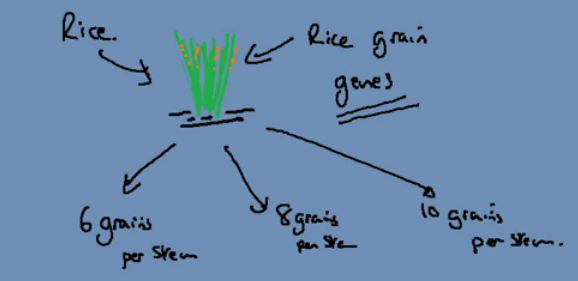
The number of rice grains is in the control of genes, the farmer wants to improve the number of rice grain per plant (increase the yield). He notices some plants have 6 grains per stem and others have 8 or 10 grains per stem. The farmers decision is to harvest the plants with 6 & 8 grains per plant and use the other grains (10 grains per stem) for planting.

He notices the next generation of rice the grains increased to 8,10 and 12 grains per stem. Therefore he harvest the 8 and 10 grain stems and selects the 12 grain ones for breeding and planting.
In this way the number of grains of rice will gradually increase = yield increases. This is an example of selective breeding


Saturday, 18 February 2012

5.9 - Fish Farming


5.9 explain the methods which are used to farm large numbers of fish to provide a source of protein, including maintenance of water quality, control of intraspecific and interspecific predation, control of disease, removal of waste products, quality and frequency of feeding and the use of selective breeding.

Fish are an attractive product for farmers since they have low fat and high protein. Also they are efficient at turning their nutrient into fish mass.

  • Fish farming allows us to control the quality of water (we want it to be clean)
  • We can control predators
  • We can reduce pests and other forms of disease

By controlling all these factors we contribute to an increase in the yield of fish. However where you have a high density of fish there is a higher chance of the transmission of diseases. That is why some fish farmers use antibiotics, this is a concern to human health.
The abundance of fish within a farm makes pests common which leads to farmers using pesticides which is also a concern to human health

5.8 - Fermenter

5.8 interpret and label a diagram of an industrial fermenter and explain the need to provide suitable conditions in the fermenter, including aseptic precautions, nutrients, optimum temperature and pH, oxygenation and agitation, for the growth of microorganisms

The industrial fermenter is the reaction vessel in which fermentation occurs. It is usually made of metals such as steel or copper.

  • The fermenter has a steel jacket outside and another steel jacket inside and in between the 2 there is water. (This is a cooling jacket because once the fermentation gets going it produces heat and this will cool down the reaction so it happens at optimal conditions)
  • The fermenter will need to be cleaned therefore there is inlet where steam goes in to sterilize the fermenter (between fermentations)
  • Within a fermenter there will be a heating plate to raise the temperature. The heating plate and cooling jacket are used to control the temperature so that it can provide the optimum temperature for fermentation
  • So the fermentation can occur there is a tap (pipework) to insert nutrients because they act as the food for the micro-organisms.
  • There is also a temperature probe to monitor the temperature. This will tell us to deploy either the heater or cooling jacket.
  • The reaction also needs the addition of micro-organisms through another tap
  • There will also be a pH probe to effect the pH to keep the optimum conditions for fermentation to occur 
  • Also there needs to be a way to stir the reaction therefore we add a motor to a mechanism that agitates the mixture preventing to clump together.
  • At the end of the reaction there needs to be a way to drain off the product, this would then go on to a process called "downstream processing" which involves purification.
The idea of a fermenter is to control the optimum growth conditions for the micro-organism so that it can produce the product we are looking for.

Wednesday, 15 February 2012

5.7 Bacteria in the Production of Yoghurt

5.7 understand the role of bacteria (Lactobacillus) in the production of yoghurt


  • Milk comes from the cow
  • Treat the milk to remove pathogens (Pasteurisation)
  • Milk sugars are converted to lactic acid (by incubating the milk at 45/6 oC and adding lactobacillus
  • The lactobacillus produces the enzymes that break down the milk sugars to produce lactic acid
  • The acid will result in a lower pH (acidic condition) which causes milk proteins to solidify.
  • This is what we call yoghurt

5.5 - Yeast the Production of Beer

5.5 understand the role of yeast in the production of beer

Beer is largely ethanol, an alcohol molecule which is produced from glucose. Glucose is broken down to ethanol and carbon dioxide (anaerobic respiration).

Glucose--------[[Yeast]]---------> Ethanol + Carbon dioxode
Yeast supplies the enzymes to bring about this conversion.

The ethanol is the alcohol in beer. It can be flavoured by adding plants such as hops. The glucose comes from starch which is converted into maltose and then into glucose:
Starch -----[[Amylase]]----->Maltose----[[Maltase]]---->Glucose

Strach comes from sources such as barley seeds, wheat seeds and even rice. The starch is broken down through the germination of seeds, known as Malting.


5.4b - Biological control


5.4 understand the reasons for pest control and the advantages and disadvantages of using pesticides and biological control with crop plants
Biological control:
Is when and alien specie is introduced from another country to eat the pest.
An example of this is in Australia when the prickly pear cactus (pest) of north america was first introduced into gardens and escaped into the countryside and flourished under the Australian climate system. The cactus spread all over Australia into a good deal of agricultural land and it was necessary to get rid of it since there was no natural herbivore of the cactus. Therefore and alien specie was introduced for another country (a moth). This moth was introduced and had no competitors so they started to remove the prickly pear cactus.
Advantages:
  • No toxic chemicals involved
  • Less impact on man and wildlife   
Disadvantage:
  • Not 100% effective
  • Difficult to control (Danger that the introduced alien specie starts feeding on native species causing native species to diminish)
  • Difficult to match predator to the prey (cant find predatory herbivores to remove the pest)

Tuesday, 14 February 2012

5.4a - Pesticides


5.4 understand the reasons for pest control and the advantages and disadvantages of using pesticides and biological control with crop plants


Pests use crops as their food source which reduces the productivity of the farm ( = -crop yield) and this has a financial impact on the farmer because he is producing less. Therefore farmers use pesticides.
Pesticides are chemicals designed to kill pests. There are both advantages and disadvantages of using pesticides.


Adv:

  • Pesticides are easy to obtain
  • It is also easy to apply to crops
  • It is extremely effective and kill pests
Dis:
  • It is toxic and can kill other plants and animals and can also harm humans
  • Bio-accumulation is when the pesticides build up through the food chain causing problems to animals in higher trophic levels
  • Mutation happens and the pests often become resistant against a pesticide so it will have to be applied at a higher level or find an alternative pesticide which can be even more dangerous